



New Delhi: Good health begins with good hygiene, but creating a cleaner and healthier India is not just about changing everyday habits. It is also about recognising and supporting the people who work every day to keep our surroundings clean. This is the idea behind Dettol Banega Swasth India, Reckitt’s public health and hygiene campaign launched in 2014 in partnership with NDTV. Over the years, the initiative has worked towards improving health and hygiene awareness, encouraging better sanitation practices and bringing communities together for a healthier India.
As the country observes World Toilet Day on November 19, the focus also turns to an important group that often remains behind the scenes: sanitation workers. They clean our streets, maintain public toilets, collect waste and keep sanitation systems running. However, their own health and safety often do not receive the attention they deserve.
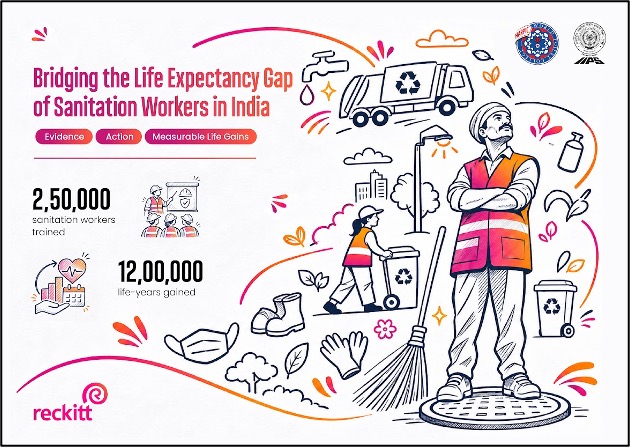
This is where Reckitt’s Harpic World Toilet College (HWTC) comes in. Established in 2018 in partnership with the World Toilet Organisation, the initiative works towards improving the lives of sanitation workers through training, safety awareness, healthcare support and livelihood opportunities. Its larger aim is to help bridge the gap in life expectancy between sanitation workers and other occupational groups.
Why Sanitation Workers Need More Attention
A recent report, Bridging the Life-Expectancy Gap of Sanitation Workers in India, developed by the International Institute for Population Sciences (IIPS) in collaboration with Reckitt, highlights the challenges faced by this workforce.
According to the study, sanitation workers in India have an estimated life expectancy of 63.8 years, compared with 75.2 years for professional, technical and managerial workers. That is a difference of 11.4 years. The report also estimates that sanitation workers lose 77,458 years of life per 1 lakh workers due to premature deaths.
The risks are closely linked to the nature of their work. Many workers face exposure to toxic gases, infectious waste and unsafe working conditions. Entering drains and sewers without proper protective equipment, handling waste with bare hands and working without regular health checks can put their lives at risk.
The report also highlights the financial challenges faced by sanitation-worker households. Their average monthly per-capita expenditure stands at ₹3,357, the lowest among the occupational groups studied. Healthcare expenses add to the burden, with out-of-pocket health spending accounting for 17.4% of their monthly household expenditure.
These findings show why sanitation work needs to be looked at beyond cleanliness. Worker safety, access to healthcare, financial protection and better employment opportunities are equally important.
Gaurav Jain, Executive Vice President, South Asia, Reckitt, said, “At Reckitt, we exist to deliver better health in more hands, every day. Sanitation workers play a critical role in safeguarding public health, yet many continue to face risks that impact their health, safety and livelihoods. As we focus on moving from life span to healthier life, this report highlights both the scale of the challenge and the opportunity to drive meaningful change. Through Harpic World Toilet College, we have worked to equip sanitation workers with skills, safety knowledge and livelihood opportunities that support safer and more secure futures. The findings reinforce our belief that improving outcomes for sanitation workers requires a combination of skilling, technology, stronger social protection and collaborative action. By translating evidence into action, we can help create healthier lives, safer workplaces and greater dignity for the sanitation workers.”
Dr Srinivas Goli, Associate Professor, International Institute for Population Sciences (IIPS), Mumbai, said, “India has added years to life over recent decades, but not for everyone. A sanitation worker’s life expectancy is 63.8 years. That is 11.4 years less than a professional, and 9.6 years less than farm and manual workers with much the same income and schooling. Poverty alone does not explain this gap. For every other occupation we studied, living in a city adds years to life. For sanitation workers, it does the opposite. Urban men in this work have the lowest life expectancy we measured, 62.3 years, about nine years below urban men nationally. About three in ten recorded deaths among sanitation workers are poisoning deaths, against roughly one in twenty in other occupations. When excess deaths cluster in one cause like that, it points to a specific exposure at work, and one that mechanisation and gas detection can remove.”
How Harpic World Toilet College Is Making A Difference
Harpic World Toilet College aims to address these challenges by giving sanitation workers access to practical training and opportunities to improve their working conditions. According to the IIPS report, the College had trained more than 2,50,000 sanitation workers by August 2026.
Its approach goes beyond basic cleaning skills. The programme focuses on the most hazardous sanitation tasks, including sewer and septic-tank cleaning, along with public-toilet cleaning. It also works towards helping workers move into safer and more formal employment.
One of its key initiatives is a two-day residential orientation programme, divided into four broad areas: inspiration, skills and safety, innovation, and growth and livelihoods.
The first day begins with an introduction to the College, the sanitation sector and opportunities available to workers. Alumni stories and pre-training assessments are also part of the process. The training then moves to practical skills, including housekeeping, cleaning methods, the correct use of products and proper working postures.
Safety is another major part of the programme. Workers are introduced to occupational hazards, workplace safety and laws related to manual scavenging. Demonstrations on the use of personal protective equipment (PPE) and handwashing, along with information on government welfare schemes, are also included.
The second day focuses on innovation and livelihood opportunities. Workers learn about water conservation and sanitation technologies, including equipment designed to make cleaning tasks easier and safer. The sessions also cover financing options, health and wellness, professional behaviour, communication skills, interview preparation and employment readiness. Assessments, certification and dignity-kit distribution are also part of the programme.
From Training To Better Livelihood Opportunities
An important part of HWTC’s work is helping sanitation workers explore employment options beyond hazardous cleaning jobs. The programme includes a multilingual digital curriculum, certification and support with placement in other, non-hazardous roles.
An independent evaluation of the College’s 2018–2020 training cohort, conducted under the Social Return on Investment (SROI) framework, reported encouraging outcomes. Among the participants assessed, 98% reported an increase in dignity, while 91.6% said they had developed greater appreciation for their work. Around 83.3% gained technical and soft skills, and 76% reported reduced stigma or increased acceptance within their communities.
The evaluation also found that 48% of participants moved from informal to formal employment, while 44% reported an increase in income. These findings underline the role that training can play in improving not just workplace skills but also confidence, social acceptance and financial stability.
Making Safety And Healthcare Part Of The Solution
HWTC’s approach also includes interventions beyond classroom training. These include providing personal protective equipment, connecting workers with relevant government schemes, vaccinations, primary health check-ups, referrals and counselling.
The programme is also exploring technology-led solutions, including wearable smart toxic-gas detectors, low-cost gas sensors, multilingual chatbots and augmented and virtual reality tools to help workers understand occupational risks. A sanitation-incident dashboard is another part of the proposed approach.
The IIPS report also highlights the need to connect training with equipment, health insurance and better monitoring of workplace safety. After all, training workers about risks is only one part of the solution; they also need access to the right tools and protection while doing their jobs.
As World Toilet Day brings conversations around sanitation and public health into focus, initiatives such as Harpic World Toilet College highlight an equally important part of the discussion: the people who make sanitation possible. A healthier India needs clean surroundings, but it also needs safer workplaces, better healthcare and dignified livelihoods for the workers who keep them that way.


